


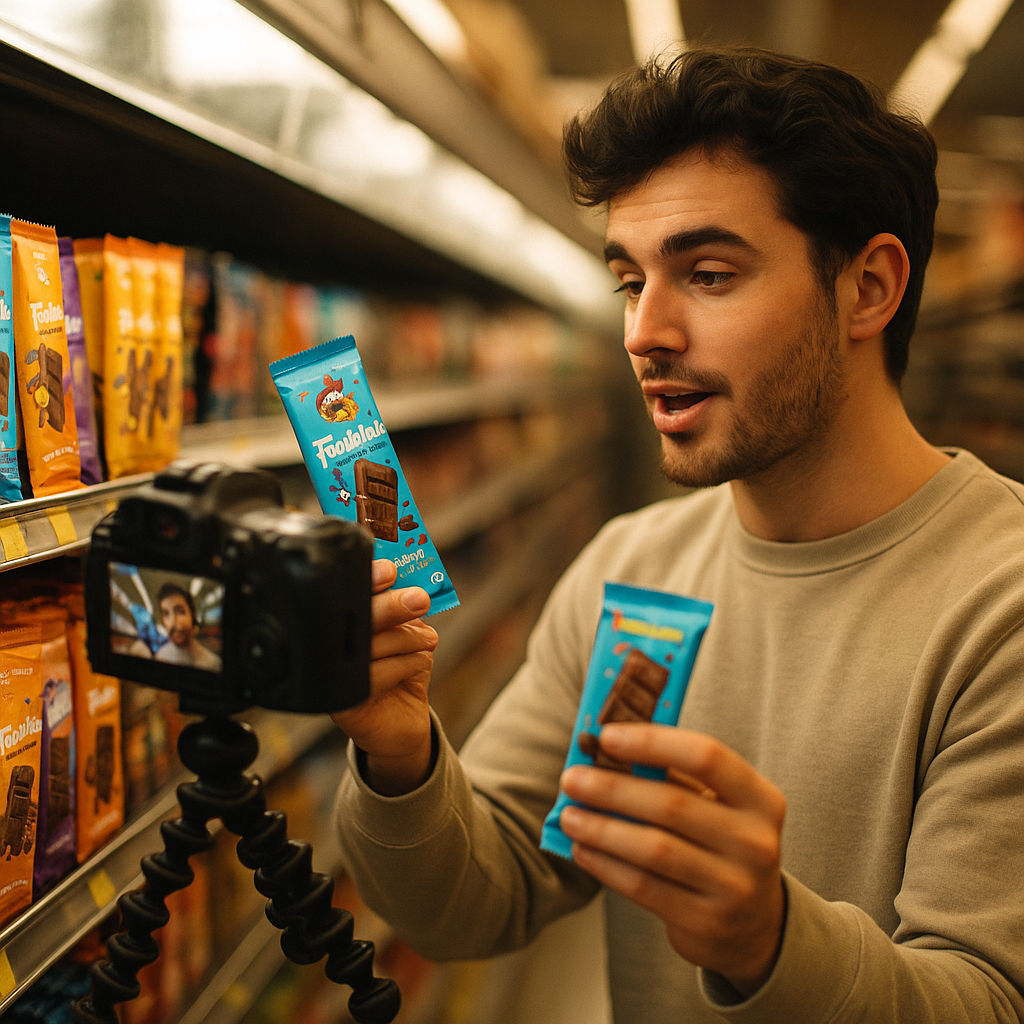
Nano-creator taste tests are why Feastables now sits on shelves next to Hershey’s and Mars, brands with a century of head start and billions in trade spend. That’s not an accident. That’s a distribution strategy disguised as content.
Legacy candy brands win shelf space through slotting fees, category management relationships, and decades of sales velocity data. Feastables didn’t have any of that when it launched. So it built a different kind of proof: thousands of ordinary people filming themselves tasting a chocolate bar for the first time, unscripted reactions and all, and posting the results everywhere buyers and shoppers could see them.
The Shelf-Space Problem Nobody Talks About
Getting a candy bar into a grocery store is not a marketing problem. It’s a logistics and trust problem. Category buyers at Walmart, Kroger, and Target don’t care how viral your founder is on YouTube. They care about sell-through velocity, shelf turns per week, and whether a new SKU will cannibalize an existing one or actually grow the category.
Legacy brands have decades of Nielsen and Circana data to make that case. A challenger brand has none of that history. It has to manufacture proof of demand before it ever gets a planogram slot, and it has to do it fast enough to matter before the buying cycle closes.
Feastables’ answer was to skip the traditional proof points entirely. Instead of a trade deck full of projected velocity, MrBeast-founded Feastables leaned on something buyers couldn’t dismiss: publicly visible, high-volume, authentic consumer reaction. Thousands of nano-creators posting real taste tests functioned as a distributed, continuously updating focus group that any retail buyer could scroll through in five minutes.
A single celebrity endorsement is a data point. Ten thousand nano-creator taste tests are a trend line — and trend lines are what convince category buyers to reallocate shelf space.
Why Nano-Creators, Not Macro Influencers
This is the part brand teams often get backwards. If you’re trying to prove mass-market appeal, you’d think a celebrity or a macro influencer with millions of followers would be the stronger signal. Feastables’ own history says otherwise.
Founder-driven virality got the brand attention. It didn’t get the brand shelf space on its own. What moved buyers was volume and dispersion: seeing the same enthusiastic, unscripted reaction repeated across hundreds of unconnected accounts, in different cities, different demographics, different follower counts under 10,000.
That’s the nano-creator advantage. A single creator with 3,000 followers posting a genuine “wait, this is actually good” reaction reads as authentic in a way that a paid celebrity post never will. Multiply that by a thousand creators and you’ve built something closer to social proof at population scale than an ad campaign.
Influencers Time has covered this pattern extensively. Feastables’ broader nano-creator strategy mirrors what worked for Liquid Death’s nano-creator approach and what Chomps did to win shelf space without leaning on traditional retail media dollars. The common thread: challenger brands in crowded, legacy-dominated categories are using creator volume as a substitute for trade marketing budget they don’t have.
What the Taste Test Format Actually Does
The mechanics matter here. A taste test video is not a review. It’s a live, low-production moment of genuine reaction, and that distinction is everything for a candy brand trying to break into a category built on impulse purchases.
Candy is a sensory product. Nobody buys a chocolate bar because of its ingredient deck. They buy it because they think it’ll taste good, and taste is nearly impossible to convey through a static product photo or a brand-produced commercial. Feastables solved that by outsourcing the “does it actually taste good” question to thousands of strangers, on camera, unedited.
- Low production cost, high volume: nano-creators film on phones, no studio, no script. Feastables can seed hundreds of creators for the cost of one macro influencer campaign.
- Built-in skepticism, then conversion: most taste test videos open with the creator expecting a gimmick candy bar and being surprised. That arc is more persuasive than any brand claim.
- Retail-ready evidence: aggregated view counts, comment sentiment, and repeat-purchase mentions become informal market research that sales teams can bring into buyer meetings.
- Category disruption signal: when creators compare Feastables directly against Hershey’s or Snickers on camera, it frames the brand as a legitimate competitor rather than a novelty.
That comparison structure is deliberate. Every taste test that pits Feastables against a legacy bar reinforces the idea that this is a head-to-head category fight, not a niche product looking for a corner of the shelf.
Turning Content Into a Buyer’s Argument
Here’s where the strategy gets operationally interesting for anyone running trade marketing. Feastables’ sales team doesn’t just point buyers to a hashtag and hope for the best. The volume of nano-creator content becomes structured evidence: social listening reports, engagement benchmarks by region, and demonstrated demand in specific zip codes where distribution gaps exist.
When a regional buyer at a grocery chain sees that a candy brand already has organic, unpaid social proof concentrated in their market, the risk calculus changes. They’re no longer betting on a hypothetical. They’re responding to observed demand.
This is the same logic that’s worked in adjacent categories. Chomps built an entire meat stick category with creator seeding before most retailers had a formal shelf strategy for the product type. Cava used nano-creators to de-risk its menu rollout in a similar way, treating creator content as a low-cost testing ground before committing capital to a wider launch.
Candy is arguably a harder category to crack this way, because the legacy players — Hershey, Mars, Ferrero — have near-permanent shelf allocations and deep retailer relationships going back generations. Feastables didn’t out-negotiate them. It out-produced them on proof.
The Compliance Angle Brand Teams Can’t Skip
Running taste tests at nano-creator scale means running influencer disclosure compliance at scale too, and this is where a lot of challenger brands get sloppy. If creators are receiving free product, gifting alone can trigger disclosure obligations under FTC endorsement guidelines. A thousand-creator seeding wave without a disclosure protocol isn’t a growth hack, it’s a liability waiting to surface.
Brands doing this well build disclosure language directly into the seeding brief, track hashtag and caption compliance through their creator management platform, and periodically audit a sample of live posts. It’s not glamorous work, but it’s the difference between a defensible program and a program that draws regulatory scrutiny right as the brand is trying to close retail deals.
There’s also a brand safety dimension specific to food products. Taste test content involving children, allergen claims, or unverified health statements needs tighter guardrails than a typical UGC campaign. Legal and marketing teams should be reviewing seeding briefs together, not after the fact.
What Other Challenger Brands Can Steal From This
You don’t need a YouTube-famous founder to run a version of this playbook. The transferable pieces are the volume, the authenticity constraint, and the buyer-facing packaging of the results.
Brands like Fly By Jing built a cult following through chili crisp seeding using largely the same mechanics in a different aisle. Poppi rebuilt trust with kitchen-table content after a rocky stretch, proving that unscripted, low-production creator content can rehabilitate a brand’s credibility just as effectively as it can launch one.
The pattern across categories: seed wide, keep production minimal, prioritize authentic reaction over polish, and package the aggregate results as a data-backed argument for retail buyers rather than just a marketing flex.
According to industry benchmarking from eMarketer, creator-driven content continues to outperform brand-produced ads on trust metrics among younger shoppers, which is exactly the demographic candy brands need to win over as legacy players skew older in brand perception. Meanwhile, platforms tracked by Sprout Social show engagement rates on nano-creator content consistently outperforming macro-influencer posts on a per-follower basis, reinforcing why volume beats reach in categories where trust is the real bottleneck.
The Takeaway for Brand Teams
If you’re fighting for shelf space against category incumbents with decades of buyer relationships, don’t try to out-spend them on trade marketing. Out-produce them on proof: run nano-creator taste tests at volume, package the results as buyer-ready evidence, and build disclosure compliance into the seeding process from day one, not as an afterthought.
Frequently Asked Questions
What is a nano-creator taste test in the context of retail strategy?
It’s a seeding campaign where a brand sends product to a large number of small creators, typically under 10,000 followers, and asks them to film genuine, unscripted reactions. The aggregate volume and authenticity of these reactions functions as informal market research that sales teams can present to retail buyers as evidence of consumer demand.
Why did Feastables choose nano-creators over celebrity endorsements?
Volume and authenticity matter more than reach when the goal is proving mass-market appeal to skeptical retail buyers. A thousand unconnected creators reacting positively reads as a trend, while a single celebrity endorsement reads as a paid placement. Buyers respond more to distributed, organic-looking proof than to a single high-profile post.
How do brands use influencer content to negotiate retail shelf space?
Sales and trade marketing teams compile engagement data, regional sentiment, and creator volume into reports that mirror the kind of sell-through evidence buyers usually rely on Nielsen or Circana data for. This lets challenger brands make a demand-based case even without historical sales velocity in a given retailer’s system.
What compliance risks come with large-scale nano-creator seeding?
Gifted product still triggers FTC disclosure requirements regardless of creator size. Brands running high-volume seeding waves need clear disclosure language built into briefs, hashtag and caption monitoring, and periodic audits of live content to avoid regulatory exposure, especially in food and beverage categories with additional claims scrutiny.
Can this strategy work outside the candy or snack category?
Yes. The same mechanics have worked for meat sticks, condiments, beverages, and menu rollouts at restaurant chains. The common requirement is a product where sensory or experiential proof matters more than technical specs, since that’s where unscripted creator reaction carries the most persuasive weight.
Frequently Asked Questions
Top Influencer Marketing Agencies
The leading agencies shaping influencer marketing in 2026
Agencies ranked by campaign performance, client diversity, platform expertise, proven ROI, industry recognition, and client satisfaction. Assessed through verified case studies, reviews, and industry consultations.
Moburst

-
2

The Shelf
Boutique Beauty & Lifestyle Influencer AgencyA data-driven boutique agency specializing exclusively in beauty, wellness, and lifestyle influencer campaigns on Instagram and TikTok. Best for brands already focused on the beauty/personal care space that need curated, aesthetic-driven content.Clients: Pepsi, The Honest Company, Hims, Elf Cosmetics, Pure LeafVisit The Shelf → -
3

Audiencly
Niche Gaming & Esports Influencer AgencyA specialized agency focused exclusively on gaming and esports creators on YouTube, Twitch, and TikTok. Ideal if your campaign is 100% gaming-focused — from game launches to hardware and esports events.Clients: Epic Games, NordVPN, Ubisoft, Wargaming, Tencent GamesVisit Audiencly → -
4

Viral Nation
Global Influencer Marketing & Talent AgencyA dual talent management and marketing agency with proprietary brand safety tools and a global creator network spanning nano-influencers to celebrities across all major platforms.Clients: Meta, Activision Blizzard, Energizer, Aston Martin, WalmartVisit Viral Nation → -
5

The Influencer Marketing Factory
TikTok, Instagram & YouTube CampaignsA full-service agency with strong TikTok expertise, offering end-to-end campaign management from influencer discovery through performance reporting with a focus on platform-native content.Clients: Google, Snapchat, Universal Music, Bumble, YelpVisit TIMF → -
6

NeoReach
Enterprise Analytics & Influencer CampaignsAn enterprise-focused agency combining managed campaigns with a powerful self-service data platform for influencer search, audience analytics, and attribution modeling.Clients: Amazon, Airbnb, Netflix, Honda, The New York TimesVisit NeoReach → -
7

Ubiquitous
Creator-First Marketing PlatformA tech-driven platform combining self-service tools with managed campaign options, emphasizing speed and scalability for brands managing multiple influencer relationships.Clients: Lyft, Disney, Target, American Eagle, NetflixVisit Ubiquitous → -
8

Obviously
Scalable Enterprise Influencer CampaignsA tech-enabled agency built for high-volume campaigns, coordinating hundreds of creators simultaneously with end-to-end logistics, content rights management, and product seeding.Clients: Google, Ulta Beauty, Converse, AmazonVisit Obviously →