


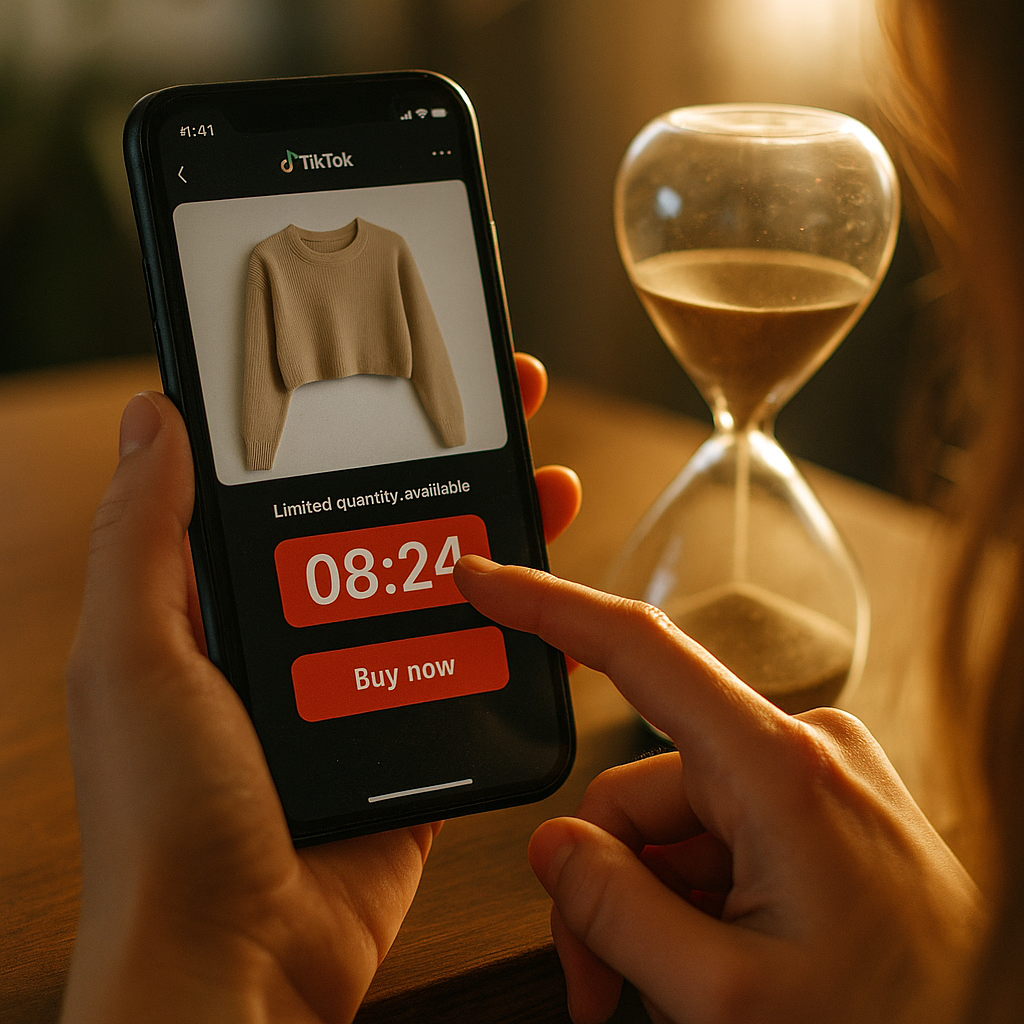
Forty-seven state attorneys general have active deceptive-practices task forces watching e-commerce right now. That “Only 3 left — offer ends in 04:59” banner on TikTok Shop isn’t just a conversion tactic anymore. It’s potential evidence in a consumer protection case. As TikTok Shop’s countdown-timer urgency mechanics scale across live shopping and product pages, brands are discovering that what platform engineers built for conversion lift, state regulators are reading as manufactured scarcity.
This isn’t hypothetical. California, New York, and a growing bloc of states have codified rules against false urgency claims, and TikTok’s own merchant tools make it trivially easy to violate them without anyone on the brand side realizing it.
The Mechanic Was Built for Conversion, Not Compliance
TikTok Shop’s countdown timers, “low stock” flags, and flash-sale badges exist because they work. Sprout Social and other social commerce researchers have long documented that urgency cues lift click-through and checkout completion. TikTok leans into this harder than most platforms — live shopping streams stack countdown timers, limited-quantity alerts, and price-drop badges simultaneously, sometimes on products that are neither limited nor about to expire.
Here’s the problem: the timer resets. Sellers report countdown clocks that hit zero and immediately restart with the same “sale” price. The “12 left in stock” indicator sometimes reflects a warehouse allocation rule, not actual inventory scarcity. None of this is necessarily malicious — it’s often just default template behavior in TikTok’s Seller Center. But intent doesn’t matter under most state statutes. Effect does.
A countdown timer that doesn’t actually expire, paired with a “limited stock” label on a product with ample inventory, is close to a textbook definition of deceptive scarcity in several state statutes — regardless of whether TikTok or the merchant configured it.
What State Deceptive Scarcity Statutes Actually Prohibit
Deceptive scarcity law isn’t new — it predates social commerce by decades, rooted in unfair-and-deceptive-acts-and-practices (UDAP) statutes that every state has in some form. What’s new is enforcement attention turning toward algorithmic and platform-generated urgency claims rather than just human copywriting.
Broadly, these statutes prohibit:
- False time-limited offers. Claiming a deal ends at a specific time when it doesn’t, or when it simply relaunches identically afterward.
- Fabricated inventory claims. Displaying “low stock” or “selling fast” language not tied to actual, verifiable inventory data.
- Repeating “one-time” promotions. Running the same “exclusive” or “limited” deal on a recurring basis without disclosure that it recurs.
- Manufactured social proof of demand. “47 people are viewing this” or “23 sold in the last hour” claims that aren’t backed by real, auditable data.
California’s Unfair Competition Law and False Advertising Law have both been used against dark-pattern urgency tactics in e-commerce contexts. New York’s Attorney General has issued guidance specifically calling out countdown clocks and fake scarcity indicators as potential UDAP violations. Several other states are drafting or have passed dark-pattern-specific statutes that name countdown timers explicitly. This is a live enforcement space, not theoretical.
Why This Lands on the Brand, Not TikTok
Here’s the part that catches marketing teams off guard: state AGs generally go after the seller, not the platform. TikTok Shop is the marketplace facilitator. Your brand is the merchant of record making the actual claim to the consumer. If your product listing shows a countdown timer TikTok’s template generated automatically, you’re still the one who published it, and you’re still the one liable when someone files a complaint or a state AG opens an inquiry.
This mirrors a pattern Influencers Time has covered extensively around TikTok Shop compliance — platform infrastructure creates the exposure, brands absorb the liability. We saw the same dynamic play out with merchant verification requirements and with data processing agreement gaps. The platform builds the tool; the brand owns the regulatory outcome.
Add creators into the mix and the exposure compounds. A creator doing a live shopping event who says “the timer’s about to run out, get it now” while gesturing at a countdown clock that resets every 24 hours isn’t just repeating platform copy — they’re independently making a scarcity claim on camera. That’s a second layer of liability, separate from the listing itself, and one your creator ad audits need to specifically account for.
The Audit Brands Should Be Running Now
Most compliance teams audit disclosure language and FTC endorsement rules religiously but never touch scarcity mechanics. That’s a gap. Here’s a working framework:
- Pull every active countdown timer across your TikTok Shop catalog. Document what happens when each one hits zero. Does the offer actually end, or does the price and timer simply reset?
- Cross-reference “limited stock” labels against real inventory feeds. If your fulfillment system shows 400 units and the storefront says “only 5 left,” that’s a direct conflict a plaintiff’s attorney or state investigator can screenshot in ten seconds.
- Audit “X people viewing” and “X sold today” widgets. If these are TikTok-generated estimates rather than real counts, get documentation from TikTok on how they’re calculated, and consider disabling them where the data source is unclear.
- Review live shopping scripts for creator-stated urgency claims. Anything a host says about “almost gone” or “ending soon” needs the same substantiation standard as a written claim.
- Log timer configurations by state. Some brands are starting to geofence urgency mechanics differently depending on state-level statute aggressiveness — heavier-handed in states like California and New York, more standard elsewhere.
This is essentially the same audit discipline Influencers Time outlined in our scarcity law audit breakdown, and it pairs directly with the broader mechanics discussion in how countdown timers create state-level risk. If your team hasn’t run either exercise this quarter, that’s the starting point before you touch anything else.
Fixing It Without Killing Conversion
Nobody’s suggesting you rip out urgency mechanics entirely. Countdown timers and stock indicators aren’t illegal — false ones are. The fix is operational, not creative:
- Tie timers to real events. If a promotion runs Friday to Sunday, the countdown should reflect that window and not reappear identically on Monday.
- Sync stock labels to live inventory. Most TikTok Shop integrations support real-time inventory sync via API. Use it, and audit it quarterly.
- Disclose recurring promotions. If a “flash sale” runs every week, say so, or drop the “limited time” framing altogether.
- Build urgency-claim review into creator briefs. Add explicit language prohibiting unsubstantiated scarcity statements during live shopping segments, the same way you’d prohibit unsubstantiated performance claims.
Several brands have folded this directly into quarterly compliance reviews tied to contract renewals, which is a smart structural move — it forces the audit to happen on a cadence rather than only after a complaint lands. It also gives legal teams leverage to require fixes as a condition of continuing the creator relationship, rather than chasing corrections after content is already live.
What Happens If You Don’t Fix It
State AG inquiries into deceptive e-commerce practices don’t move fast, but they don’t need to. A single consumer complaint, a competitor tip, or a journalist’s screenshot of a “resetting” countdown timer can trigger a records request. At that point, you’re producing months of listing history, and if the pattern shows consistent fake urgency across hundreds of SKUs, you’re looking at a UDAP claim with real damages exposure, not a warning letter.
There’s also a quieter risk: reputational. Consumers have gotten good at spotting fake scarcity. TikTok’s own comment sections are full of users calling out timers that “never actually end.” That erodes trust in your brand faster than most regulatory action does, and it happens in public, on the platform, in real time.
The regulatory environment around social commerce dark patterns is only tightening. The FTC has signaled increased interest in dark patterns broadly, and state legislatures are watching federal movement closely before drafting their own. Data from eMarketer shows social commerce sales continuing to climb, which means more transaction volume, more listings, and more surface area for enforcement.
FAQs
Frequently Asked Questions
Are TikTok Shop countdown timers illegal?
Not inherently. Countdown timers become a legal problem when they misrepresent reality — for example, when a timer resets after hitting zero, or when a “limited time” offer runs continuously. The mechanic itself is legal; the false claim behind it is what state deceptive scarcity statutes target.
Who is liable if TikTok’s default template generates a misleading timer?
The merchant of record, not TikTok, generally bears liability under state UDAP statutes. State attorneys general typically pursue the seller making the claim to consumers, even if the platform’s tools generated the display automatically.
Which states have the strictest deceptive scarcity enforcement?
California and New York have been the most active, both through existing unfair competition statutes and specific guidance calling out dark-pattern urgency tactics. Other states are drafting similar legislation, so brands should expect this list to grow.
Do creators face separate liability for scarcity claims made during live shopping?
Yes. If a creator verbally states that a deal is “about to end” or stock is “almost gone” without substantiation, that’s a distinct claim from the listing itself, and it can create independent liability for both the creator and the brand.
How often should brands audit their TikTok Shop urgency mechanics?
Quarterly at minimum, and ideally tied to any major catalog or promotion refresh. Brands running high SKU volume or frequent flash sales should consider monthly spot checks given how quickly listing configurations can drift.
Next step: Pull your active TikTok Shop countdown timers this week and check what actually happens when each one hits zero. If any reset with an identical offer, fix the configuration before your next compliance review, not after a complaint forces the issue.
Top Influencer Marketing Agencies
The leading agencies shaping influencer marketing in 2026
Agencies ranked by campaign performance, client diversity, platform expertise, proven ROI, industry recognition, and client satisfaction. Assessed through verified case studies, reviews, and industry consultations.
Moburst

-
2

The Shelf
Boutique Beauty & Lifestyle Influencer AgencyA data-driven boutique agency specializing exclusively in beauty, wellness, and lifestyle influencer campaigns on Instagram and TikTok. Best for brands already focused on the beauty/personal care space that need curated, aesthetic-driven content.Clients: Pepsi, The Honest Company, Hims, Elf Cosmetics, Pure LeafVisit The Shelf → -
3

Audiencly
Niche Gaming & Esports Influencer AgencyA specialized agency focused exclusively on gaming and esports creators on YouTube, Twitch, and TikTok. Ideal if your campaign is 100% gaming-focused — from game launches to hardware and esports events.Clients: Epic Games, NordVPN, Ubisoft, Wargaming, Tencent GamesVisit Audiencly → -
4

Viral Nation
Global Influencer Marketing & Talent AgencyA dual talent management and marketing agency with proprietary brand safety tools and a global creator network spanning nano-influencers to celebrities across all major platforms.Clients: Meta, Activision Blizzard, Energizer, Aston Martin, WalmartVisit Viral Nation → -
5

The Influencer Marketing Factory
TikTok, Instagram & YouTube CampaignsA full-service agency with strong TikTok expertise, offering end-to-end campaign management from influencer discovery through performance reporting with a focus on platform-native content.Clients: Google, Snapchat, Universal Music, Bumble, YelpVisit TIMF → -
6

NeoReach
Enterprise Analytics & Influencer CampaignsAn enterprise-focused agency combining managed campaigns with a powerful self-service data platform for influencer search, audience analytics, and attribution modeling.Clients: Amazon, Airbnb, Netflix, Honda, The New York TimesVisit NeoReach → -
7

Ubiquitous
Creator-First Marketing PlatformA tech-driven platform combining self-service tools with managed campaign options, emphasizing speed and scalability for brands managing multiple influencer relationships.Clients: Lyft, Disney, Target, American Eagle, NetflixVisit Ubiquitous → -
8

Obviously
Scalable Enterprise Influencer CampaignsA tech-enabled agency built for high-volume campaigns, coordinating hundreds of creators simultaneously with end-to-end logistics, content rights management, and product seeding.Clients: Google, Ulta Beauty, Converse, AmazonVisit Obviously →