


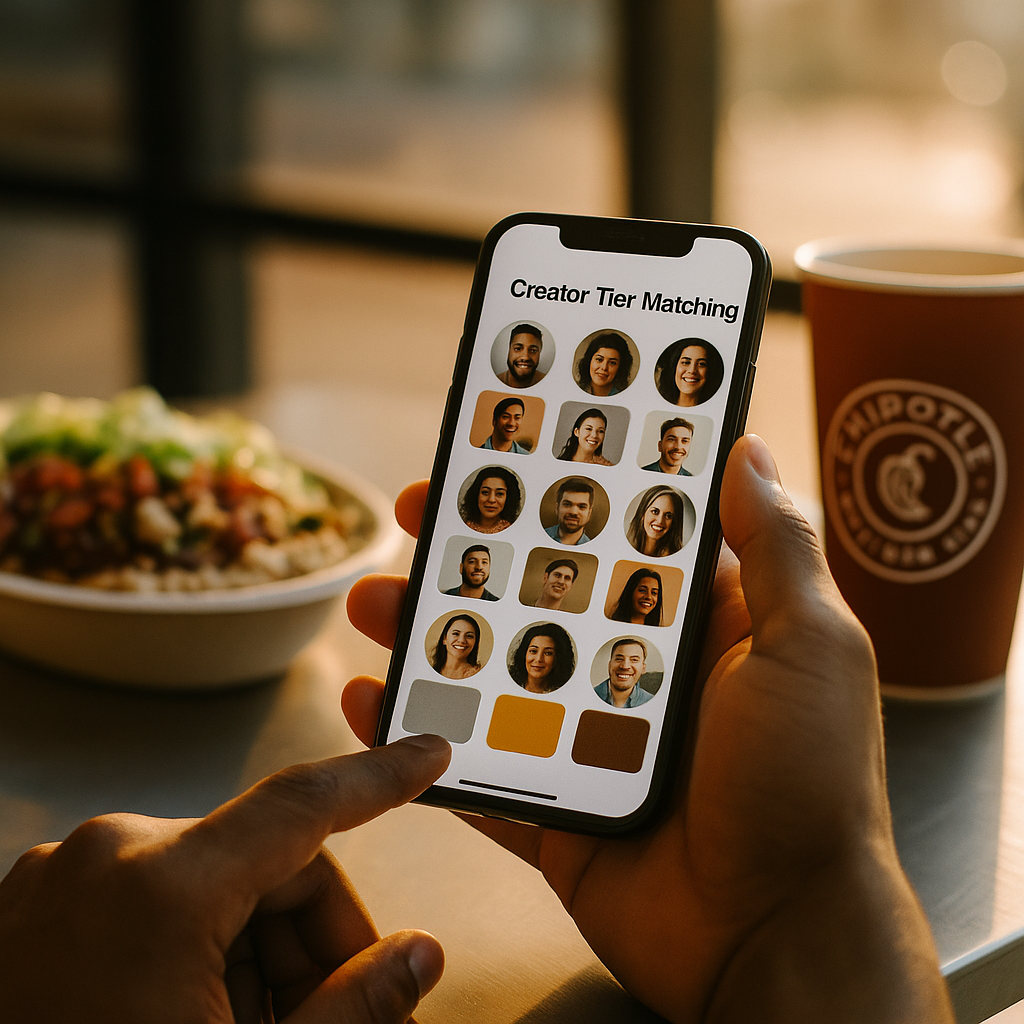
Can a burrito chain really run creator partnerships like a hedge fund runs trades? Programmatic creator matching made it possible for Chipotle to activate more than 700 brand-equivalent partner tiers for a single menu-item push, and the results are forcing marketers to rethink how they scale influencer programs beyond spreadsheets and gut instinct.
The Problem With Scaling Creator Campaigns the Old Way
Most brands hit a wall around 50 to 100 active creators. Not because budget runs out, but because the operational overhead of manual vetting, outreach, contracting, and briefing collapses under its own weight. Chipotle’s marketing team faced exactly this ceiling ahead of a limited-time menu item launch that needed national reach fast, with regional flexibility baked in.
The traditional playbook: a few dozen mid-tier creators, a handful of celebrity endorsements, and a wave of paid amplification. It works, but it’s slow and expensive per unit of reach. Chipotle wanted something closer to programmatic ad buying, where matching happens algorithmically against defined criteria rather than through manual relationship management.
Chipotle’s team treated creator selection like a media buy, not a talent booking. That single shift in mindset is what allowed 700+ partner tiers to run simultaneously without breaking the internal team.
What “Brand-Equivalent Partner Tiers” Actually Means
This is the part that trips up a lot of marketing leads. “Tiers” here doesn’t mean the usual nano, micro, mid, and macro buckets. Chipotle’s system, built on an LTK-style programmatic matching model, segmented creators by brand-equivalence: audience demo overlap, content tone, regional relevance, past conversion performance, and even menu-item affinity (a creator who’s posted about spicy food gets prioritized for a jalapeño-forward LTO, for example).
Each tier represents a distinct combination of these variables, not just follower count. That’s why the number balloons to 700+. It’s less “we hired 700 influencers” and more “we defined 700 audience-and-context combinations, then let the platform find the best-fit creator for each one, automatically.”
- Geographic tier: creators mapped to specific Chipotle store trade areas for localized promotion.
- Content-format tier: short-form recipe hacks, unboxing, taste-test reactions, POV ordering content.
- Audience-affinity tier: fitness, budget-eats, college life, late-night snacking, family meals.
- Performance-history tier: creators re-activated based on prior campaign conversion data.
This is similar to the segmentation logic other QSR brands have used when moving from broad seeding to precision targeting. Influencers Time covered a comparable shift in AI-generated content workflows for QSR brands, where speed and specificity replaced generic briefs.
How the Matching Engine Actually Worked
Programmatic creator matching platforms, LTK being the most visible example, operate on a logic borrowed straight from ad tech: define the audience you want, feed the algorithm historical performance data, and let it surface creators who statistically over-index for your goal. Chipotle’s team fed the system with:
- First-party sales data tied to previous LTO campaigns, segmented by region and demo.
- Content performance benchmarks (completion rate, saves, comment sentiment) from past creator partnerships.
- Real-time creator inventory, meaning who’s active, available, and within brand-safety thresholds right now.
The output wasn’t a list Chipotle’s team scrolled through manually. It was a live, continuously updated roster that adjusted as creators accepted or declined briefs, as content went live, and as early performance signals came in. If a tier underperformed in week one, the system reallocated budget toward tiers that were converting, mid-flight.
That’s a meaningfully different operating model than the static “book 40 creators, wait six weeks, run a report” approach still common at a lot of CPG and QSR brands. For context on how automation is reshaping seeding decisions elsewhere in food and beverage, see how a grocer beat CPG cost-per-sale benchmarks with AI seeding, a comparable case of algorithmic allocation beating manual selection on cost efficiency.
Why 700 Tiers Beats 70 Creators
Here’s the counterintuitive part. You’d think managing 700 anything would be harder than managing 70. It’s actually the opposite, if the matching layer is doing its job. Chipotle’s marketing ops team didn’t individually manage 700 relationships. They managed one system, with defined rules, and let automation handle allocation.
The efficiency gain shows up in three places:
- Cost per acquisition drops because budget flows to whatever tier is converting, not whatever tier was contracted first.
- Time to launch compresses because briefing and matching happen algorithmically instead of through weeks of manual outreach.
- Content diversity increases because 700 micro-segments naturally produce more varied creative than 40 creators working off the same brief.
This mirrors what Stanley did with its Quencher rollout, activating hundreds of micro-creator waves instead of a handful of big names. That case, detailed in how Stanley’s micro-creator waves built the Quencher, showed similar logic: breadth plus specificity beats depth plus generality when the goal is category-wide saturation.
The Compliance Question Nobody Wants to Ask
Running 700+ partner tiers sounds like a disclosure nightmare. It isn’t, if the platform layer handles it correctly, but it can become one fast if it doesn’t. Every creator across every tier still needs to comply with FTC endorsement guidelines, and at this scale, manual disclosure audits are basically impossible.
Chipotle’s approach leaned on the matching platform’s built-in disclosure enforcement, flagging non-compliant posts automatically and pausing payout until corrected. This is the operational reality of scaling: compliance has to be engineered into the system, not policed after the fact. Brands that have learned this the hard way, including the fallout covered in how Poppi rebuilt trust after its FTC settlement, illustrate exactly why automated compliance checks aren’t optional at this volume.
At 700+ active tiers, manual compliance review isn’t a bottleneck, it’s a liability. Automated disclosure enforcement is the only way the math works.
What the Data Showed
Chipotle hasn’t published granular campaign numbers publicly, but the directional results align with broader industry data on programmatic creator matching. According to eMarketer research on influencer marketing efficiency, brands using algorithmic matching platforms report meaningfully lower cost-per-engagement than brands relying on manual creator selection, largely because allocation shifts toward proven performers in near real time rather than waiting for post-campaign reporting.
Internally, the signals that mattered to Chipotle’s team weren’t vanity metrics. They tracked:
- Regional sales lift tied to specific creator tiers, matched against store-level POS data.
- Content-to-conversion time, meaning how quickly a piece of creator content translated to app orders or in-store visits.
- Creator retention rate across tiers, a proxy for whether the matching logic was actually finding good fits or just filling quotas.
That last metric matters more than people realize. High creator churn within a tier usually means the matching criteria are off, not that the creators are bad. Chipotle’s team used churn as a diagnostic signal to refine tier definitions mid-campaign, something that’s simply not possible in a static, manually-booked program.
What Other Brands Should Steal From This
You don’t need Chipotle’s budget to apply the logic. The underlying principle, matching creators to context-specific tiers rather than broad follower-count buckets, works at any scale. A regional coffee chain or a DTC skincare brand can run the same playbook with a fraction of the tiers.
The coffee brand that tripled ROAS with AI creator matching proved this works well below QSR-national scale. Same logic, smaller footprint. The core question every brand should ask before scaling a creator program: are you matching creators to your business outcomes, or just to your budget line?
For teams still managing creator programs through spreadsheets and manual outreach, the gap between that approach and what programmatic matching enables is only going to widen. Platforms like LTK, Aspire, and GRIN have all moved toward this model, and the brands adopting it early are compounding an efficiency advantage that’s getting harder to close.
Frequently Asked Questions
FAQs
What is programmatic creator matching?
Programmatic creator matching uses algorithms to pair brands with creators based on audience data, past performance, and contextual relevance, similar to how programmatic ad buying automates media placement. It replaces manual creator vetting with rules-based, real-time allocation.
How did Chipotle use LTK-style matching for its menu campaign?
Chipotle segmented creators into more than 700 brand-equivalent tiers based on geography, content format, audience affinity, and past performance, then let a matching platform allocate campaign budget and briefs dynamically across those tiers rather than manually booking each creator.
Is programmatic creator matching only for large brands with big budgets?
No. Smaller brands can apply the same tiering logic on a reduced scale, using fewer, tighter creator segments. The principle, matching creators to specific business contexts rather than broad follower tiers, scales down as effectively as it scales up.
How does compliance work at this scale?
Compliance has to be automated. Manual review of disclosures across hundreds of creator tiers isn’t feasible, so brands rely on platform-level enforcement that flags non-compliant content and withholds payout until FTC disclosure requirements are met.
What metrics matter most for evaluating a programmatic creator campaign?
Regional sales lift tied to specific tiers, content-to-conversion time, and creator retention rate within tiers are more useful than raw impressions or follower counts, since they reflect whether the matching logic is actually driving business outcomes.
Next step: before your next campaign, audit whether your creator selection process is matching to business outcomes or just filling a budget line, then pilot a programmatic matching platform on a single product line before scaling it brand-wide.
FAQs
What is programmatic creator matching?
Programmatic creator matching uses algorithms to pair brands with creators based on audience data, past performance, and contextual relevance, similar to how programmatic ad buying automates media placement. It replaces manual creator vetting with rules-based, real-time allocation.
How did Chipotle use LTK-style matching for its menu campaign?
Chipotle segmented creators into more than 700 brand-equivalent tiers based on geography, content format, audience affinity, and past performance, then let a matching platform allocate campaign budget and briefs dynamically across those tiers rather than manually booking each creator.
Is programmatic creator matching only for large brands with big budgets?
No. Smaller brands can apply the same tiering logic on a reduced scale, using fewer, tighter creator segments. The principle, matching creators to specific business contexts rather than broad follower tiers, scales down as effectively as it scales up.
How does compliance work at this scale?
Compliance has to be automated. Manual review of disclosures across hundreds of creator tiers isn’t feasible, so brands rely on platform-level enforcement that flags non-compliant content and withholds payout until FTC disclosure requirements are met.
What metrics matter most for evaluating a programmatic creator campaign?
Regional sales lift tied to specific tiers, content-to-conversion time, and creator retention rate within tiers are more useful than raw impressions or follower counts, since they reflect whether the matching logic is actually driving business outcomes.
Top Influencer Marketing Agencies
The leading agencies shaping influencer marketing in 2026
Agencies ranked by campaign performance, client diversity, platform expertise, proven ROI, industry recognition, and client satisfaction. Assessed through verified case studies, reviews, and industry consultations.
Moburst

-
2

The Shelf
Boutique Beauty & Lifestyle Influencer AgencyA data-driven boutique agency specializing exclusively in beauty, wellness, and lifestyle influencer campaigns on Instagram and TikTok. Best for brands already focused on the beauty/personal care space that need curated, aesthetic-driven content.Clients: Pepsi, The Honest Company, Hims, Elf Cosmetics, Pure LeafVisit The Shelf → -
3

Audiencly
Niche Gaming & Esports Influencer AgencyA specialized agency focused exclusively on gaming and esports creators on YouTube, Twitch, and TikTok. Ideal if your campaign is 100% gaming-focused — from game launches to hardware and esports events.Clients: Epic Games, NordVPN, Ubisoft, Wargaming, Tencent GamesVisit Audiencly → -
4

Viral Nation
Global Influencer Marketing & Talent AgencyA dual talent management and marketing agency with proprietary brand safety tools and a global creator network spanning nano-influencers to celebrities across all major platforms.Clients: Meta, Activision Blizzard, Energizer, Aston Martin, WalmartVisit Viral Nation → -
5

The Influencer Marketing Factory
TikTok, Instagram & YouTube CampaignsA full-service agency with strong TikTok expertise, offering end-to-end campaign management from influencer discovery through performance reporting with a focus on platform-native content.Clients: Google, Snapchat, Universal Music, Bumble, YelpVisit TIMF → -
6

NeoReach
Enterprise Analytics & Influencer CampaignsAn enterprise-focused agency combining managed campaigns with a powerful self-service data platform for influencer search, audience analytics, and attribution modeling.Clients: Amazon, Airbnb, Netflix, Honda, The New York TimesVisit NeoReach → -
7

Ubiquitous
Creator-First Marketing PlatformA tech-driven platform combining self-service tools with managed campaign options, emphasizing speed and scalability for brands managing multiple influencer relationships.Clients: Lyft, Disney, Target, American Eagle, NetflixVisit Ubiquitous → -
8

Obviously
Scalable Enterprise Influencer CampaignsA tech-enabled agency built for high-volume campaigns, coordinating hundreds of creators simultaneously with end-to-end logistics, content rights management, and product seeding.Clients: Google, Ulta Beauty, Converse, AmazonVisit Obviously →