


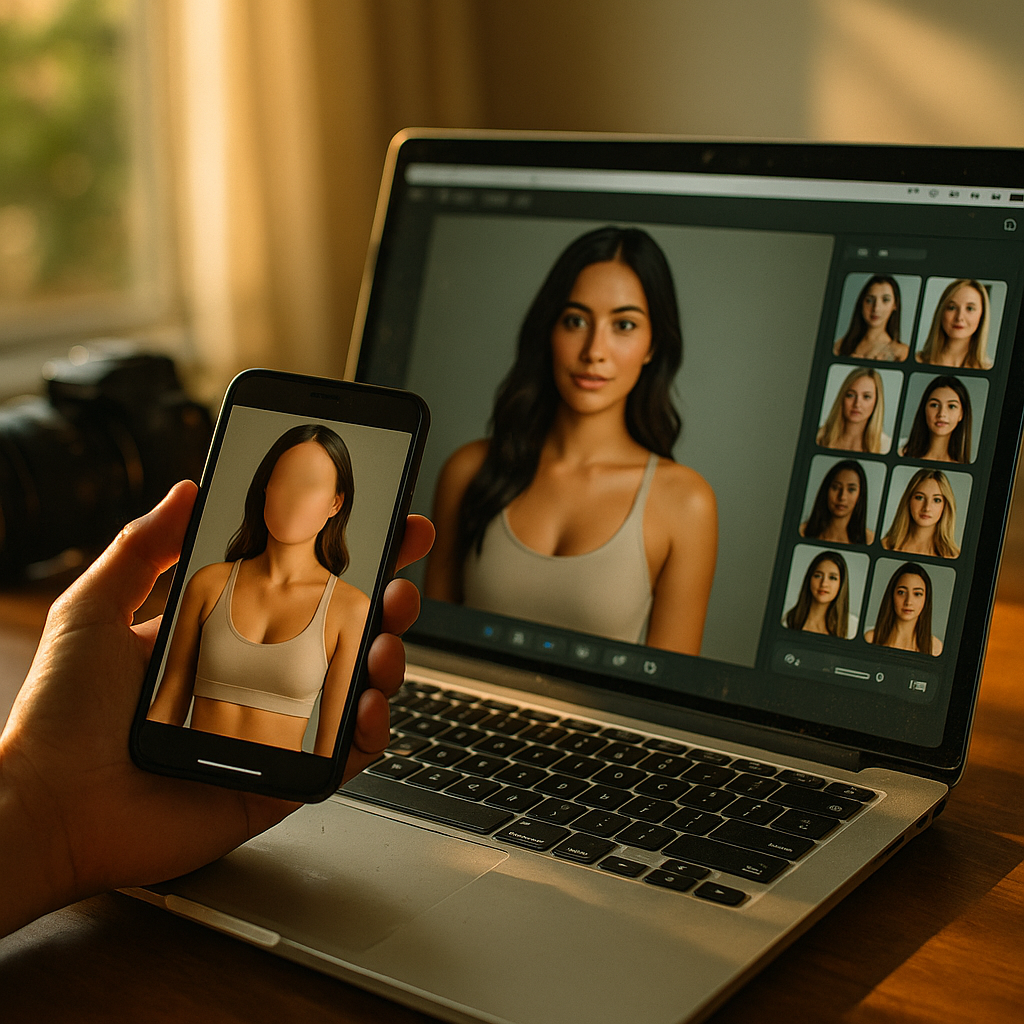
Sixty-four percent of marketers say sourcing enough creator content is their biggest bottleneck, according to recent creator economy surveys, yet budgets for real-creator shoots keep shrinking. Enter faceless UGC: ad creative built entirely from AI avatars, synthetic voices, and generative video tools, no camera, no talent contract, no scheduling nightmare. Is it a shortcut or the future of performance creative?
What “Faceless UGC” Actually Means
Forget the literal reading. Faceless UGC doesn’t mean content without a face onscreen, it means content without a real human behind that face. Brands now generate spokesperson-style ads using AI avatar platforms like Synthesia, HeyGen, and Captions, pairing synthetic presenters with cloned or fully generated voices. The result looks and sounds like the scrappy, handheld UGC that’s dominated feeds since 2020, but nobody had to show up to set.
The format borrows the visual grammar of authentic creator content: direct-to-camera delivery, casual lighting, product-in-hand framing. It just swaps the human for a synthetic stand-in trained on stock footage, licensed likeness data, or a fully generated persona. For brands running hundreds of ad variants a month, that’s a production shortcut with real financial weight.
Faceless UGC doesn’t replace the creator economy, it replaces the shoot day. The strategy, hooks, and offers still come from marketers who understand what converts.
Why Brands Are Testing It Right Now
Three pressures converge here: rising creator rates, platform fatigue with polished ads, and the sheer volume performance marketing demands. A single paid social program can require dozens of creative variants weekly to fight ad fatigue and keep CPMs down, a challenge covered in depth in our piece on creative briefs that lower CPMs. Booking that volume of real creators is expensive and slow. AI avatars compress a two-week shoot cycle into an afternoon.
There’s also the localization angle. A single avatar script can be regenerated in a dozen languages without re-shooting, similar in spirit to the workflow we outlined in AI dubbed creator content. For global brands running the same offer across markets, that’s not a nice-to-have, it’s a budget-line reduction.
And frankly, some categories just need volume over intimacy. Software demos, subscription upsells, app tutorials, these don’t need a beloved creator’s personal brand attached. They need clarity, speed, and enough variants to find the winning hook.
Where the Format Actually Performs
Early adopters report mixed but instructive results. Avatar-led UGC tends to outperform traditional brand ads on watch-through rate (because it mimics familiar creator pacing) but underperforms genuine creator content on trust-based metrics like comment sentiment and save rate. In other words: it scales impressions fine, it doesn’t yet scale belief.
- Top-of-funnel awareness ads: avatars work well for cold audiences who haven’t built parasocial trust with any creator yet.
- Product explainer and demo content: functional, instructional formats where personality matters less than clarity.
- Rapid A/B hook testing: generating 20 variations of an opening line without booking 20 shoots.
- Multilingual rollout: one script, many markets, no re-cast.
Where it struggles: bottom-funnel trust content, anything requiring perceived vulnerability, and categories like beauty, wellness, or finance where audiences actively hunt for signs of a real person’s lived experience. Compare this to the rise of formats like flaw-revealing UGC or intentionally imperfect content, both built on the premise that visible humanity is the conversion driver. Faceless UGC sits at the opposite end of that spectrum, and audiences notice the difference faster than marketers expect.
The Compliance Question Nobody’s Skipping Anymore
Regulators are not far behind the trend. The Federal Trade Commission has already signaled that synthetic endorsers must be disclosed the same way paid human endorsements are, and platforms are building labeling requirements for AI-generated content into their ad policies. If your avatar implies a real person’s experience with your product, without disclosing it’s synthetic, you’re exposed.
The UK’s Information Commissioner’s Office has also weighed in on synthetic media and data provenance, particularly where voice cloning touches personal likeness rights. Before scaling an avatar program, legal should confirm: is the avatar fully synthetic, or trained on a real person’s licensed likeness? Those carry very different liability profiles.
An undisclosed AI avatar posing as a genuine customer testimonial isn’t a gray area, it’s a disclosure violation waiting for a complaint.
Best practice right now: label avatar-led content clearly in ad metadata, avoid framing it as a “real customer” testimonial, and keep a documented consent trail if any real likeness or voice was used as training data. Treat it with the same rigor you’d apply to compliance-safe urgency formats, where the format’s power depends entirely on staying inside platform and regulatory rules.
Cost and Speed: The Real Business Case
Let’s talk numbers, because that’s what gets this format budget approval. A traditional creator shoot with usage rights, editing, and revisions can run anywhere from a few hundred to several thousand dollars per asset, depending on creator tier. Avatar platforms typically operate on subscription pricing, often producing dozens of variants for a flat monthly fee well below a single mid-tier creator booking.
Speed compounds the savings. A brief that would take two weeks to cast, shoot, and edit can be turned around in a single day with an avatar workflow. For performance teams running constant creative refresh cycles, similar to the rapid iteration described in studio-style UGC production, that turnaround is the entire point.
According to eMarketer research on ad production costs, creative fatigue now sets in faster than ever on short-form video feeds, pushing brands toward higher-volume, lower-cost variant testing. Faceless UGC fits that math cleanly, even if it doesn’t yet fit every brand story.
Building a Hybrid Workflow (Because Pure Faceless Rarely Wins Alone)
The smartest teams aren’t choosing avatars instead of creators, they’re choosing avatars alongside them. Use real creators for trust-heavy, top-tier hero content, the kind featured in founder-led video or authentic unboxing formats, then use AI avatars to scale the long tail: localized versions, minor hook variants, and lower-stakes explainer ads that never needed a real face to begin with.
Think of it as a content ladder. Real creators build the emotional and trust layer at the top. Avatars handle volume and iteration underneath. That mirrors the structure in our discovery to conversion content ladder, where one core asset seeds many downstream variants. Faceless UGC simply becomes another rung, not a replacement for the whole ladder.
Practical rollout steps:
- Audit your funnel to identify which ad slots actually require human trust versus functional clarity.
- Pilot avatar creative on top-of-funnel and explainer placements only, measure against existing creator benchmarks.
- Build a disclosure and labeling standard before scaling spend, not after a complaint.
- Reserve real-creator budget for testimonial, review, and bottom-funnel trust content.
- Track sentiment, not just CTR, avatar backlash shows up in comments before it shows up in conversion data.
What to Watch Before You Scale
Platform policy is moving fast. Meta and TikTok have both introduced or signaled AI-content labeling requirements, and Meta’s advertising standards now touch synthetic media disclosure directly. Check current policy before launching a large avatar campaign, rules that applied last quarter may already be outdated.
Audience tolerance is also generational and category-dependent. Gen Z audiences raised on TikTok are often more forgiving of visible AI content, treating it as a stylistic choice rather than deception, provided it’s not pretending to be a genuine customer. Older demographics and trust-sensitive categories (health, finance, parenting) show far less patience for synthetic spokespeople. Test before you assume.
FAQs
What is faceless UGC in advertising?
Faceless UGC refers to ad creative styled like authentic user-generated content but performed by AI avatars instead of real human creators, using synthetic video and voice generation tools.
Is faceless UGC legal to run in ads?
Yes, but disclosure matters. Regulators including the FTC expect synthetic endorsers to be clearly labeled, especially if the content implies a genuine customer experience.
Does AI avatar content convert as well as real creator content?
It performs comparably on awareness and watch-through metrics but typically underperforms real creators on trust-based signals like saves, shares, and comment sentiment, particularly in bottom-funnel placements.
Which platforms are commonly used to build AI avatar ads?
Marketers commonly use tools like Synthesia, HeyGen, and Captions to generate avatar-led video ads, often paired with cloned or synthetic voice tracks.
Should brands replace all creator content with AI avatars?
No. The strongest performing programs use avatars for volume, localization, and top-of-funnel testing while reserving real creators for trust-heavy, bottom-funnel content.
Next step: pick one low-trust, high-volume ad slot, say a top-funnel product explainer, and run a four-week avatar-versus-creator test before touching your bottom-funnel budget.
FAQs
What is faceless UGC in advertising?
Faceless UGC refers to ad creative styled like authentic user-generated content but performed by AI avatars instead of real human creators, using synthetic video and voice generation tools.
Is faceless UGC legal to run in ads?
Yes, but disclosure matters. Regulators including the FTC expect synthetic endorsers to be clearly labeled, especially if the content implies a genuine customer experience.
Does AI avatar content convert as well as real creator content?
It performs comparably on awareness and watch-through metrics but typically underperforms real creators on trust-based signals like saves, shares, and comment sentiment, particularly in bottom-funnel placements.
Which platforms are commonly used to build AI avatar ads?
Marketers commonly use tools like Synthesia, HeyGen, and Captions to generate avatar-led video ads, often paired with cloned or synthetic voice tracks.
Should brands replace all creator content with AI avatars?
No. The strongest performing programs use avatars for volume, localization, and top-of-funnel testing while reserving real creators for trust-heavy, bottom-funnel content.
Top Influencer Marketing Agencies
The leading agencies shaping influencer marketing in 2026
Agencies ranked by campaign performance, client diversity, platform expertise, proven ROI, industry recognition, and client satisfaction. Assessed through verified case studies, reviews, and industry consultations.
Moburst

-
2

The Shelf
Boutique Beauty & Lifestyle Influencer AgencyA data-driven boutique agency specializing exclusively in beauty, wellness, and lifestyle influencer campaigns on Instagram and TikTok. Best for brands already focused on the beauty/personal care space that need curated, aesthetic-driven content.Clients: Pepsi, The Honest Company, Hims, Elf Cosmetics, Pure LeafVisit The Shelf → -
3

Audiencly
Niche Gaming & Esports Influencer AgencyA specialized agency focused exclusively on gaming and esports creators on YouTube, Twitch, and TikTok. Ideal if your campaign is 100% gaming-focused — from game launches to hardware and esports events.Clients: Epic Games, NordVPN, Ubisoft, Wargaming, Tencent GamesVisit Audiencly → -
4

Viral Nation
Global Influencer Marketing & Talent AgencyA dual talent management and marketing agency with proprietary brand safety tools and a global creator network spanning nano-influencers to celebrities across all major platforms.Clients: Meta, Activision Blizzard, Energizer, Aston Martin, WalmartVisit Viral Nation → -
5

The Influencer Marketing Factory
TikTok, Instagram & YouTube CampaignsA full-service agency with strong TikTok expertise, offering end-to-end campaign management from influencer discovery through performance reporting with a focus on platform-native content.Clients: Google, Snapchat, Universal Music, Bumble, YelpVisit TIMF → -
6

NeoReach
Enterprise Analytics & Influencer CampaignsAn enterprise-focused agency combining managed campaigns with a powerful self-service data platform for influencer search, audience analytics, and attribution modeling.Clients: Amazon, Airbnb, Netflix, Honda, The New York TimesVisit NeoReach → -
7

Ubiquitous
Creator-First Marketing PlatformA tech-driven platform combining self-service tools with managed campaign options, emphasizing speed and scalability for brands managing multiple influencer relationships.Clients: Lyft, Disney, Target, American Eagle, NetflixVisit Ubiquitous → -
8

Obviously
Scalable Enterprise Influencer CampaignsA tech-enabled agency built for high-volume campaigns, coordinating hundreds of creators simultaneously with end-to-end logistics, content rights management, and product seeding.Clients: Google, Ulta Beauty, Converse, AmazonVisit Obviously →