


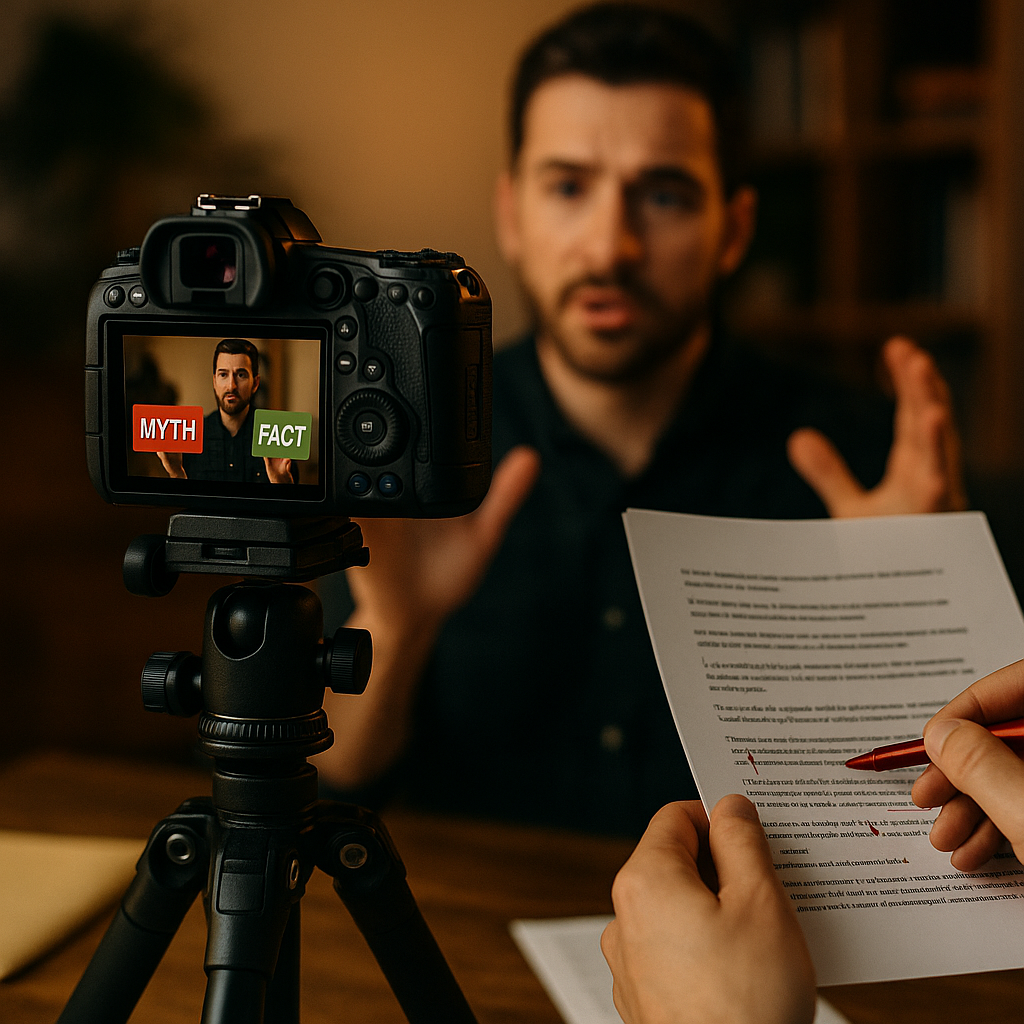
Here’s an uncomfortable number: trust in brands has been sliding for a decade, yet consumers still rank “corrects misinformation” as one of the fastest ways a brand earns credibility back. A well-scripted myth vs fact video can do more reputation work in 30 seconds than a month of polished brand content. The catch? Most brands botch the format, turning a trust-building tool into a legal liability or, worse, a yawn.
This isn’t a format you can wing. Myth vs fact videos live or die on structure, sourcing, and the split-second judgment of whether the “fact” actually holds up. Get it right and you look like the authority in your category. Get it wrong and you’ve just handed critics a screenshot.
Why This Format Works When Everything Else Feels Like an Ad
Viewers have built a reflexive skepticism toward branded content. They scroll past testimonials. They mute pre-rolls. But a myth vs fact format taps into something different: the pattern recognition of “correcting a mistake.” Our brains are wired to pay attention when something we believed turns out to be wrong. That’s not a marketing trick, it’s basic cognitive psychology, and it’s why fact-check style content consistently outperforms standard product demos on watch time.
There’s also a structural advantage. The format gives you permission to say your product’s name without sounding like a pitch, because you’re framing it as correction, not promotion. A skincare brand saying “retinol doesn’t make skin thinner, here’s the dermatology behind it” reads as education. The same brand saying “buy our retinol serum” reads as an ad. Same information, wildly different reception.
Myth vs fact content performs best when the “myth” is something your audience actually believes, not a straw man you invented to make your product look smart.
That last point trips up more brands than anything else. If your myth is too obvious, too fake, or too convenient, viewers smell it immediately. The comments section will eat you alive. Mine your customer service tickets, your Reddit mentions, your review sections for the actual misconceptions people hold. That’s your script source material, not a brainstorm session in a conference room.
Scripting the Core Structure
The format has a rhythm, and deviating from it costs you watch-through rate. Here’s the skeleton that consistently works across categories, from CPG to fintech to beauty:
- Hook (0-2 seconds): State the myth as a bold, slightly provocative claim. “Myth: sunscreen causes cancer.” Don’t hedge it. The flatter and more confident the statement, the more curiosity it generates.
- Beat (2-3 seconds): A visual or verbal pause. This is where “Fact:” appears on screen, often with a text overlay and a tonal shift (a sound cue, a cut, a change in facial expression).
- Correction (3-15 seconds): The actual explanation. This needs a credible source, a specific number, or a named expert. Vague reassurance (“that’s not true, trust us”) kills credibility instantly.
- Proof or demonstration (optional, 15-25 seconds): Show, don’t just tell. A dermatologist citation, a lab result, a side-by-side comparison.
- Soft CTA (last 3-5 seconds): Not a hard sell. Something like “that’s why we formulate ours differently” works better than “shop now.”
Keep the whole thing under 35 seconds if you’re targeting TikTok or Reels. Longer formats work on YouTube Shorts or as part of a short form video library where context and credibility have more room to breathe, but the core structure stays identical.
Writing the Myth Statement So It Doesn’t Backfire
The myth statement is the riskiest line in the whole script. Phrase it wrong and you’ve either underplayed a real concern (making your brand look dismissive) or overstated a fringe belief (making your brand look like it’s manufacturing controversy). Three rules keep this in check:
- Use language your audience actually uses. Pull exact phrasing from reviews, DMs, or comment threads. If customers say “I heard this breaks you out,” script that, not a clinical paraphrase.
- Never mock the belief. Even if the myth is objectively silly, mocking it alienates the segment of your audience who held that belief five minutes ago. Condescension kills conversion.
- Keep it to one claim per video. Stacking three myths into one script dilutes the correction and makes fact-checking harder for your legal or compliance team.
This single-claim discipline matters more than most scripts account for, and it overlaps heavily with lessons from ingredient breakdown videos, where overloading a script with too many claims is the number one reason legal review drags on.
The Fact Section Is Where Credibility Is Won or Lost
This is the part brands rush. They nail the hook, then throw a weak, unsupported “fact” into the mix because the creative team ran out of time. That’s backwards. The fact section deserves the most scripting attention, not the least.
What makes a fact section credible on camera?
- Specificity. “Studies show” is weak. “A 2023 dermatology journal review found” is strong, assuming it’s true and sourced.
- Attribution. Name the study, the body, or the expert. If you can’t name a source, you probably shouldn’t be making the claim.
- Visual backup. Text overlay citing the source while the speaker talks reinforces credibility without slowing the pace.
- Honest limits. If the fact is “it depends on skin type” rather than a clean yes/no, say that. Oversimplifying a nuanced fact to fit a punchy format is how brands end up issuing corrections later.
Every claim in this section should be run through whoever handles regulatory review before publishing, the same way you’d treat dupe comparison claims or performance comparisons in paid creative. The FTC’s guidance on endorsements and claims applies just as much to a “myth busted” video as it does to a testimonial, because you’re still making substantiated claims about your product or category.
Who Should Deliver the Script?
Delivery changes everything in this format. A founder delivering a myth vs fact script reads as personal conviction. A creator delivering the same script reads as third-party validation. A faceless voiceover with on-screen text reads as clinical and fast, which works well for highly technical categories like finance or health supplements.
There’s no universal right answer, but there’s a wrong one: having a clearly scripted actor deliver it with forced enthusiasm. Viewers can smell a read-through from a teleprompter, and nothing undermines a credibility format faster than looking like you’re performing credibility rather than demonstrating it. If you’re working with creators on this format, borrow the same groundwork used for founder rebuttal videos, where authenticity of delivery matters more than production polish.
Disclosure Still Applies, Even When It’s “Educational”
Brands sometimes assume myth vs fact content gets a pass on disclosure because it reads as informational rather than promotional. It doesn’t. If a creator is paid, gifted product, or has any material connection to your brand, the standard disclosure rules apply regardless of format. This gets especially tricky because the “educational” framing can tempt creators to skip the #ad tag, assuming it reads as neutral commentary.
Script the disclosure into the video itself, not just the caption. A simple “partnered with” line in the first few seconds protects both the brand and the creator, and it mirrors the disclosure discipline covered in anonymous confessional scripting, where ambiguity around sponsorship created real compliance exposure.
Where Myth vs Fact Videos Fit in the Broader Content Mix
This format isn’t a standalone strategy, it’s a credibility layer that works best alongside other proof points. Pair it with stitched review compilations for social proof, or with a founder origin documentary for brand story depth. Myth vs fact content does the narrow job of correcting a specific misconception quickly. It’s not built to carry your entire brand narrative, and brands that over-rely on it risk looking defensive, like they’re constantly on the back foot explaining themselves.
A healthy content calendar might run one myth vs fact video for every four or five pieces of other proof-driven content. Enough to establish you as the brand willing to address hard questions directly, not so much that your feed starts to feel like a never-ending rebuttal tour.
Measuring Whether It’s Actually Building Trust
Watch time and shares matter, but they’re not the full picture for this format. The metrics that actually indicate credibility impact:
- Comment sentiment shift. Are people thanking you for clarifying, or are they arguing back with counter-sources? The latter means your fact section wasn’t airtight.
- Branded search lift. If the myth vs fact video is working, you should see an uptick in people searching your brand name alongside the topic you addressed.
- Repeat engagement. Viewers who watch one myth vs fact video and then seek out more of your content are signaling trust transfer, not just curiosity.
- Return rate or support ticket volume on the specific concern you addressed. If you busted a myth about allergens or side effects, a drop in related support inquiries is a concrete, bottom-line signal.
Tools like Sprout Social or native platform analytics can track sentiment and comment trends, but the support ticket metric usually lives outside your social dashboard, so loop in customer service early.
Common Mistakes That Undercut the Format
A few patterns show up again and again when these scripts underperform or draw backlash:
- Inventing a myth nobody believes. This reads as a strawman and tanks trust faster than no video at all.
- Burying the source. If your “fact” requires viewers to take your word for it, you’ve recreated the trust problem you were trying to solve.
- Overclaiming certainty. Science and consumer products are rarely 100% one way. A script that admits nuance ages better than one that oversells certainty.
- Skipping legal review because it “feels educational.” Educational framing doesn’t exempt you from substantiation requirements.
- Recycling the same myth structure repeatedly. Once viewers clock the formula, novelty drops and so does watch-through.
If you’re scripting this at scale across multiple creators or markets, build a lightweight approval template, similar to what works for retail media ad review, so each script gets the same fact-check pass before it goes live.
FAQs
Frequently Asked Questions
How long should a myth vs fact video be?
For TikTok and Reels, keep it under 35 seconds. YouTube Shorts or longer-form placements can stretch to 60 to 90 seconds if the topic genuinely needs more explanation, but padding a simple correction just to hit a runtime target hurts retention.
Does a myth vs fact video count as a testimonial under FTC rules?
Not exactly, but any paid or gifted collaboration still requires clear disclosure, and any factual claim made in the video must be substantiated the same way a product claim would be. Check current guidance at the FTC’s website before publishing at scale.
Should the brand or a creator deliver the script?
Either can work. Creators add third-party credibility, founders add personal conviction, and voiceover with text overlay works well for technical or regulated categories. Choose based on how much skepticism the specific myth is likely to generate.
What’s the biggest reason these videos fail?
Weak or unsourced facts. Viewers will forgive a simple hook, but an unsubstantiated correction gets picked apart in comments and can do more damage than the original myth.
How often should this format appear in a content calendar?
Roughly one myth vs fact video for every four or five other pieces of proof-driven content works for most brands. More than that risks making the brand look perpetually defensive.
Next step: Pull your last 90 days of customer service tickets and review comments, find the three misconceptions that come up most, and script one myth vs fact video per quarter around each, with sourcing locked before a single frame gets shot.
Top Influencer Marketing Agencies
The leading agencies shaping influencer marketing in 2026
Agencies ranked by campaign performance, client diversity, platform expertise, proven ROI, industry recognition, and client satisfaction. Assessed through verified case studies, reviews, and industry consultations.
Moburst

-
2

The Shelf
Boutique Beauty & Lifestyle Influencer AgencyA data-driven boutique agency specializing exclusively in beauty, wellness, and lifestyle influencer campaigns on Instagram and TikTok. Best for brands already focused on the beauty/personal care space that need curated, aesthetic-driven content.Clients: Pepsi, The Honest Company, Hims, Elf Cosmetics, Pure LeafVisit The Shelf → -
3

Audiencly
Niche Gaming & Esports Influencer AgencyA specialized agency focused exclusively on gaming and esports creators on YouTube, Twitch, and TikTok. Ideal if your campaign is 100% gaming-focused — from game launches to hardware and esports events.Clients: Epic Games, NordVPN, Ubisoft, Wargaming, Tencent GamesVisit Audiencly → -
4

Viral Nation
Global Influencer Marketing & Talent AgencyA dual talent management and marketing agency with proprietary brand safety tools and a global creator network spanning nano-influencers to celebrities across all major platforms.Clients: Meta, Activision Blizzard, Energizer, Aston Martin, WalmartVisit Viral Nation → -
5

The Influencer Marketing Factory
TikTok, Instagram & YouTube CampaignsA full-service agency with strong TikTok expertise, offering end-to-end campaign management from influencer discovery through performance reporting with a focus on platform-native content.Clients: Google, Snapchat, Universal Music, Bumble, YelpVisit TIMF → -
6

NeoReach
Enterprise Analytics & Influencer CampaignsAn enterprise-focused agency combining managed campaigns with a powerful self-service data platform for influencer search, audience analytics, and attribution modeling.Clients: Amazon, Airbnb, Netflix, Honda, The New York TimesVisit NeoReach → -
7

Ubiquitous
Creator-First Marketing PlatformA tech-driven platform combining self-service tools with managed campaign options, emphasizing speed and scalability for brands managing multiple influencer relationships.Clients: Lyft, Disney, Target, American Eagle, NetflixVisit Ubiquitous → -
8

Obviously
Scalable Enterprise Influencer CampaignsA tech-enabled agency built for high-volume campaigns, coordinating hundreds of creators simultaneously with end-to-end logistics, content rights management, and product seeding.Clients: Google, Ulta Beauty, Converse, AmazonVisit Obviously →