


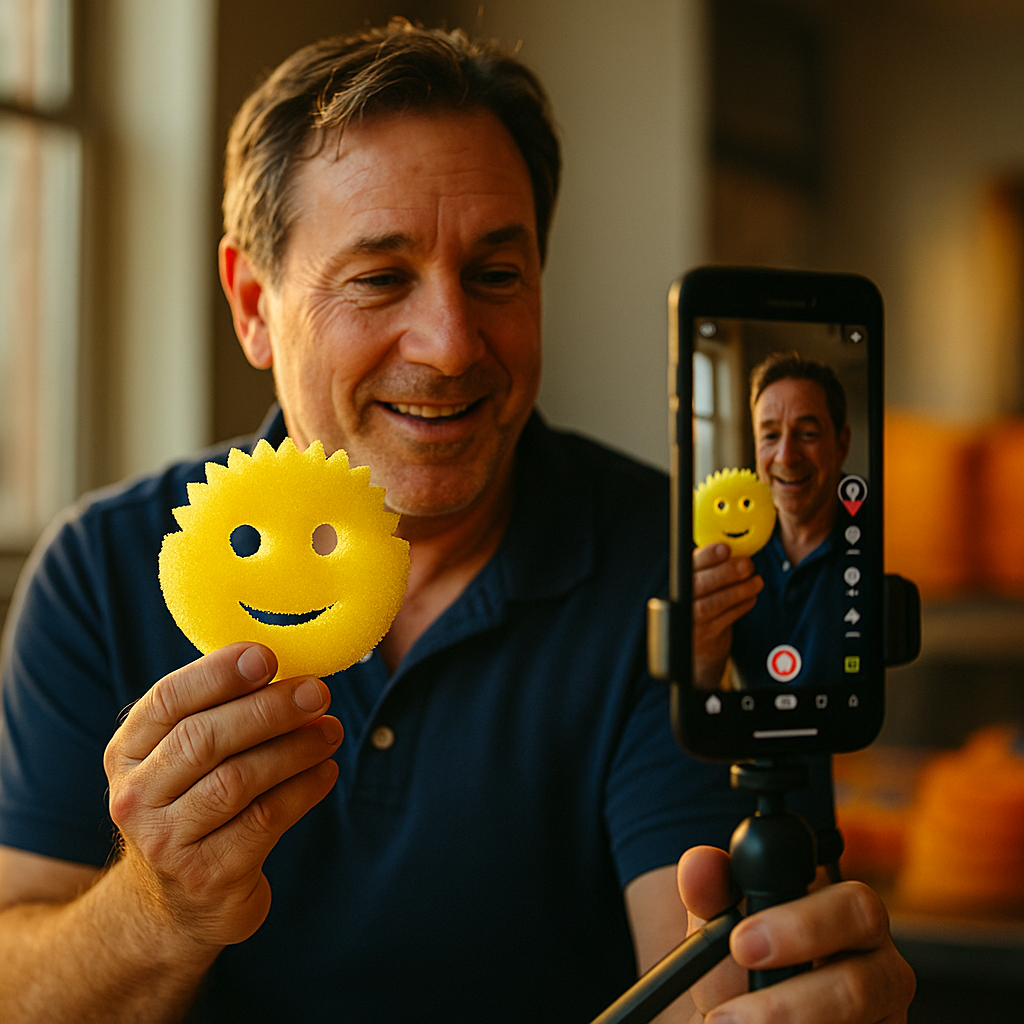
A cleaning sponge with 4.5 million TikTok followers outperforms most DTC brands with ten times the marketing budget. That’s not a fluke — it’s the result of a deliberate, founder-led TikTok presence built over years, not months. If you’re still debating whether your CEO needs to be on camera, Scrub Daddy’s post-Shark Tank run is the case study that ends the argument.
The Backstory: From Shark Tank Deal to Content Machine
Aaron Krause pitched Scrub Daddy on Shark Tank back in 2012, walking away with a $200,000 investment from Lori Greiner for 20% equity. It became one of the show’s biggest success stories, reportedly crossing $200 million in lifetime retail sales. That’s the part most business media already covered.
What gets less attention: how Scrub Daddy avoided the fate of nearly every other Shark Tank alum — a hot launch, a retail spike, then a slow fade into discount-bin obscurity. The answer wasn’t a bigger ad budget. It was Krause himself, showing up on TikTok as a recognizable, slightly goofy founder who treats a smiley-face sponge like a brand mascot with a personality.
This matters for anyone running brand strategy today. Founder-led content isn’t a nice-to-have anymore — it’s becoming a core distribution channel, and Scrub Daddy proves it works even for the least “exciting” product categories imaginable.
Why a Sponge Brand Bet on Founder-Led Content
Most B2C brands treat TikTok as a paid amplification channel: brief the agency, produce polished UGC-style ads, run them through Spark Ads, measure ROAS. Scrub Daddy did something different. Krause and his team built an organic-first content engine where the founder is the recurring character, not a guest appearance.
The strategy rests on three pillars:
- Founder as protagonist. Krause appears in a large share of top-performing videos, often reacting to customer comments, testing cleaning hacks, or defending the sponge’s honor against skeptics.
- Product personification. The sponge itself — with its trademark smiley face — is treated like a character with feelings, running jokes, and a fanbase. Comment sections read like fandom threads.
- Rapid-response content. The team reacts to trending audio, viral cleaning content, and even competitor mishaps within a day or two, not weeks.
This isn’t accidental. It mirrors what worked for Duolingo’s owl mascot strategy: a recognizable character plus a willingness to be weird on a platform that rewards personality over polish.
Scrub Daddy proves that category boredom is a marketing excuse, not a real constraint — a $5 sponge with a face has outperformed entire beauty and apparel brands on engagement rate.
The Numbers Behind the Cult Following
Scrub Daddy’s TikTok account has amassed tens of millions of likes across its catalog, with individual videos regularly clearing 5-10 million views. For context, most CPG brands on TikTok struggle to break 100,000 views on branded content without paid boost. According to Sprout Social’s engagement benchmarks, average brand engagement rates on TikTok hover in the low single digits — Scrub Daddy’s organic engagement consistently runs well above category norms.
What’s driving that gap isn’t production value. Scrub Daddy’s videos are shot cheaply, often in what looks like a garage or warehouse. The differentiator is authenticity and consistency: the same face, the same product, the same slightly unhinged energy, week after week. Audiences reward recognizability, and algorithms reward watch time, which founder-led personality content tends to generate more reliably than generic product demos.
Retail Doesn’t Kill Virality — Complacency Does
Here’s the myth worth killing: that a product needs to stay “new” to stay viral. Scrub Daddy has been sold at Walmart, Target, and Bed Bath & Beyond for over a decade. It’s about as mature a retail product as exists. Yet its TikTok relevance hasn’t decayed the way most legacy CPG brands’ has.
The reason is that Scrub Daddy treats content like a media property, not a sales funnel. Every video doesn’t need to drive an immediate purchase. Some exist purely to build affinity — reaction videos, employee cameos, sponge “origin story” lore. That affinity compounds, and it shows up later in branded search, retail pickup, and unpaid word of mouth.
This is a lesson brands like YETI and Liquid Death have also internalized: category maturity is not a ceiling on content relevance if the brand voice stays sharp and current.
What This Means for Brand and Marketing Leaders
If you’re managing an influencer or content budget right now, the Scrub Daddy case raises an uncomfortable question: are you over-indexing on external creator partnerships while under-investing in your own founder or executive as a content asset?
Founder-led content has real advantages over paid creator campaigns:
- Lower marginal cost. No usage rights negotiation, no whitelisting fees, no creator agency cut.
- Compounding brand equity. The audience builds affinity with your brand directly, not with a creator who might promote a competitor next quarter.
- Faster response cycles. A founder can react to a trend or crisis same-day; a creator brief-and-approve cycle takes days.
- Crisis resilience. A visible, likable founder is a reputational asset if things go sideways — customers already trust the face behind the brand.
None of this means creator partnerships are obsolete. Brands like Solo Stove and Stanley have shown nano-creator seeding drives real commerce outcomes at scale. But Scrub Daddy suggests founder content and creator seeding aren’t either/or — they’re complementary layers of the same distribution strategy.
The Operational Playbook, Distilled
What can a mid-sized brand actually replicate here, without an unlimited budget or a naturally charismatic CEO? A few operational takeaways stand out:
- Put a real person in front of the camera, consistently. Doesn’t have to be the CEO — a product lead, founder, or even a longtime employee works, as long as they show up repeatedly.
- Build a content cadence, not a campaign calendar. Scrub Daddy posts frequently and reactively, not in quarterly bursts tied to product launches.
- Lower production standards deliberately. Overly polished content reads as an ad. Rough, reactive content reads as real — and TikTok’s algorithm tends to reward watch time over visual polish, per TikTok’s own creative guidance for advertisers.
- Treat the comment section as a content source. Some of Scrub Daddy’s best-performing videos are direct responses to skeptical or funny comments.
- Track brand engagement separately from conversion metrics. Affinity-building content shouldn’t be judged by the same ROAS lens as a shoppable demo video, similar to the separation brands use when comparing livestream commerce performance in pieces like TikTok Shop livestream scheduling.
For B2B and mid-market brands nervous about putting leadership on camera, the risk calculus has shifted. Per eMarketer’s ongoing research on social commerce, short-form video consumption keeps climbing across every age demographic, meaning the audience for founder-led content isn’t shrinking — it’s the format increasingly expected by consumers deciding what to trust.
Where Brands Get This Wrong
A common failure mode: hiring a “TikTok creator” to impersonate founder energy instead of actually putting the founder or a real internal voice on camera. Audiences can tell. The parasocial connection that makes Scrub Daddy’s content work depends on continuity and authenticity — the same person, actually connected to the company, showing up over and over.
Another mistake is treating founder content as a one-off PR moment rather than a sustained content operation. Krause didn’t post once after Shark Tank and coast. The brand has maintained an active, high-frequency posting cadence for years, which is closer to running a media property than executing a campaign.
Compliance and Brand Safety Notes
Founder-led content carries less FTC disclosure risk than paid influencer partnerships since there’s no material connection to disclose beyond the obvious fact that it’s the company’s own account. That said, brands should still ensure any claims made on camera, cleaning performance, durability, safety, meet the same substantiation standards as traditional advertising. A founder being casual on camera doesn’t exempt the brand from truth-in-advertising obligations.
Bottom line: if your brand has a founder willing to show up on camera consistently, that’s a content asset most competitors don’t have and most agencies won’t build for you. Start with one recurring format, post it weekly for a quarter, and measure engagement lift before scaling spend anywhere else.
FAQs
What made Scrub Daddy’s TikTok strategy different from typical brand accounts?
The brand centered its content around founder Aaron Krause as a recurring on-camera presence rather than relying primarily on paid creator partnerships or polished ad-style content. This built long-term audience affinity rather than one-off campaign spikes.
Can founder-led content work for B2B or less “fun” product categories?
Yes. Scrub Daddy proves category boredom is largely a marketing excuse. The format works because it prioritizes personality, consistency, and rapid response over production value or category novelty.
Does founder-led content replace the need for creator partnerships?
No. It complements creator and nano-creator strategies rather than replacing them. Founder content builds brand affinity while creator seeding and TikTok Shop demos tend to drive more direct commerce outcomes.
How should brands measure the success of founder-led content?
Track engagement rate, watch time, and audience growth separately from conversion-focused metrics like ROAS. Affinity-building content and shoppable content serve different funnel stages and shouldn’t be judged by the same KPIs.
Are there compliance risks with founder-led social content?
Disclosure risk is lower than with paid influencer content, but brands must still ensure any product claims made on camera are accurate and substantiated per FTC advertising guidelines.
Top Influencer Marketing Agencies
The leading agencies shaping influencer marketing in 2026
Agencies ranked by campaign performance, client diversity, platform expertise, proven ROI, industry recognition, and client satisfaction. Assessed through verified case studies, reviews, and industry consultations.
Moburst

-
2

The Shelf
Boutique Beauty & Lifestyle Influencer AgencyA data-driven boutique agency specializing exclusively in beauty, wellness, and lifestyle influencer campaigns on Instagram and TikTok. Best for brands already focused on the beauty/personal care space that need curated, aesthetic-driven content.Clients: Pepsi, The Honest Company, Hims, Elf Cosmetics, Pure LeafVisit The Shelf → -
3

Audiencly
Niche Gaming & Esports Influencer AgencyA specialized agency focused exclusively on gaming and esports creators on YouTube, Twitch, and TikTok. Ideal if your campaign is 100% gaming-focused — from game launches to hardware and esports events.Clients: Epic Games, NordVPN, Ubisoft, Wargaming, Tencent GamesVisit Audiencly → -
4

Viral Nation
Global Influencer Marketing & Talent AgencyA dual talent management and marketing agency with proprietary brand safety tools and a global creator network spanning nano-influencers to celebrities across all major platforms.Clients: Meta, Activision Blizzard, Energizer, Aston Martin, WalmartVisit Viral Nation → -
5

The Influencer Marketing Factory
TikTok, Instagram & YouTube CampaignsA full-service agency with strong TikTok expertise, offering end-to-end campaign management from influencer discovery through performance reporting with a focus on platform-native content.Clients: Google, Snapchat, Universal Music, Bumble, YelpVisit TIMF → -
6

NeoReach
Enterprise Analytics & Influencer CampaignsAn enterprise-focused agency combining managed campaigns with a powerful self-service data platform for influencer search, audience analytics, and attribution modeling.Clients: Amazon, Airbnb, Netflix, Honda, The New York TimesVisit NeoReach → -
7

Ubiquitous
Creator-First Marketing PlatformA tech-driven platform combining self-service tools with managed campaign options, emphasizing speed and scalability for brands managing multiple influencer relationships.Clients: Lyft, Disney, Target, American Eagle, NetflixVisit Ubiquitous → -
8

Obviously
Scalable Enterprise Influencer CampaignsA tech-enabled agency built for high-volume campaigns, coordinating hundreds of creators simultaneously with end-to-end logistics, content rights management, and product seeding.Clients: Google, Ulta Beauty, Converse, AmazonVisit Obviously →