


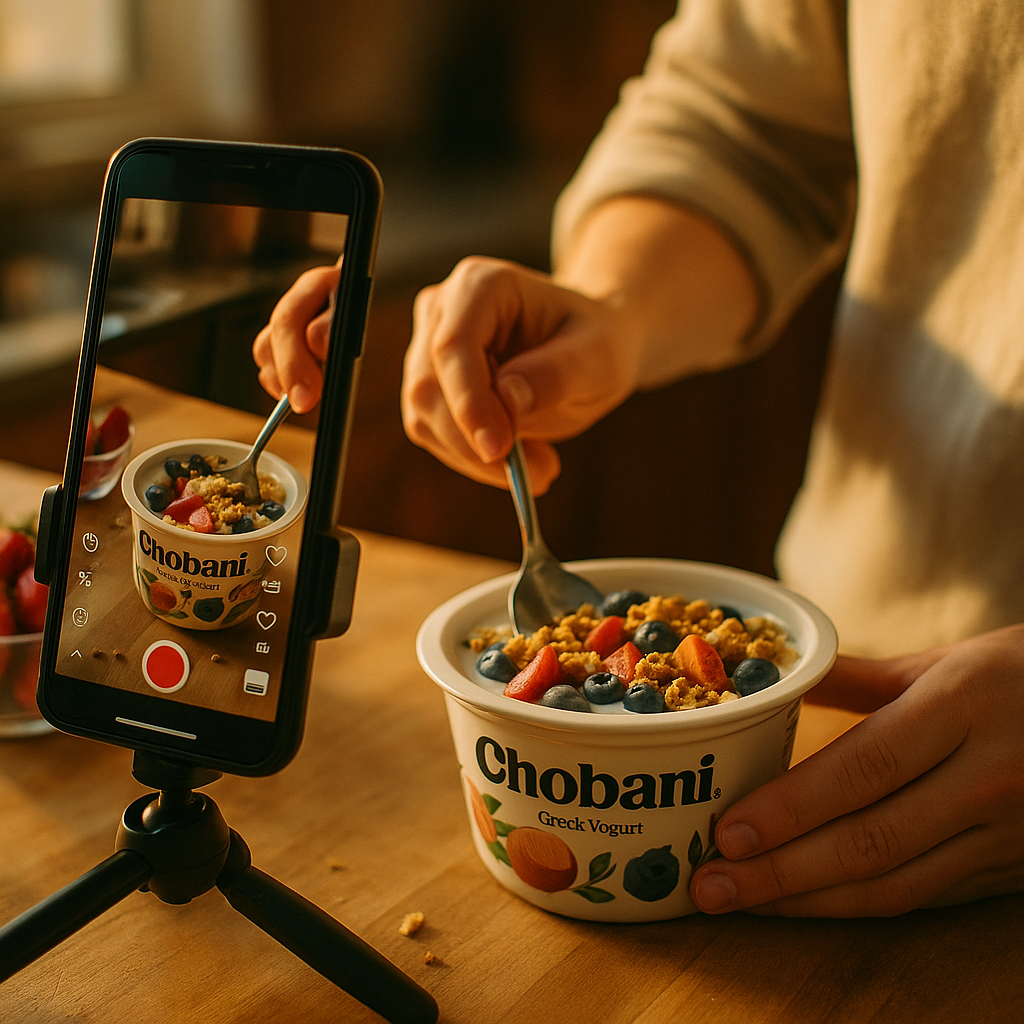
Yogurt is not a sexy category. There is no unboxing moment, no hype drop, no scarcity mechanic. So how did Chobani turn plain cups of yogurt into a recurring livestream sales channel that outperformed paid search on a per-dollar basis? The answer sits at the intersection of habit-building content and a social commerce playbook most commodity brands never bother to build.
This is the story of how a legacy dairy brand treated livestream shopping less like a marketing tactic and more like a retail channel with its own P&L.
The Commodity Problem, Restated
Yogurt brands compete on shelf space, price promos, and flavor rotation. Margins are thin. Differentiation is hard. Most CPG marketers in this category default to coupon-driven Instagram ads and hope retail media covers the rest.
Chobani took a different bet: instead of selling yogurt as a product, sell it as an ingredient in a daily ritual. The yogurt bowl. Berries, granola, honey, maybe a swirl of nut butter. It’s aspirational enough to photograph, simple enough to replicate, and — critically — repeatable. You don’t buy a yogurt bowl once. You build one every morning.
That repeatability is exactly what makes livestream commerce work. A one-time purchase decision doesn’t need a recurring content engine. A daily habit does.
Why Livestreams, Not Static Posts
Static product posts answer “what is this.” Livestreams answer “how do I use this, right now, and should I buy it before the stream ends.” For a low-consideration purchase like yogurt, that second question matters more than brand storytelling ever will.
Chobani’s approach borrowed heavily from the mechanics detailed in Chobani’s TikTok Shop playbook, where the brand treated TikTok Shop less as a discovery channel and more as a conversion surface tied directly to creator demonstrations.
Livestream commerce doesn’t sell products. It sells the fifteen seconds of proof that a product fits into a routine a viewer already has.
The format matters here. Recipe-style livestreams, where a creator builds three or four bowl variations in real time while answering comments, consistently outperformed scripted product demos. Viewers weren’t watching an ad. They were watching a cooking show with a cart button.
That distinction is the whole game. According to eMarketer’s live commerce forecasts, U.S. consumers still trail Chinese shoppers significantly in livestream shopping adoption, which means brands that get the format right now build an unfair advantage before the category matures.
Building the Creator Bench: Depth Over Star Power
Chobani did not anchor this on a handful of celebrity partnerships. It built a bench of mid-tier and nano food creators who already posted breakfast content organically, then gave them reasons to go live.
This mirrors a pattern showing up across commodity and near-commodity categories. Coffee brands have done the same thing with subscription retention, as outlined in Chamberlain Coffee’s broadcast channel strategy, where the goal isn’t reach, it’s frequency of touch with an already-converted audience.
- Nano food creators (10K-50K followers): High trust, low cost, used for daily-frequency livestreams.
- Mid-tier creators (50K-500K): Used for weekly “bowl of the week” livestream events tied to seasonal flavors.
- Registered dietitians and nutrition creators: Used sparingly, mainly to counter protein and sugar-content skepticism in real time during Q&A segments.
That third tier matters more than most brands admit. Yogurt sits in a nutrition-conscious purchase category, and live Q&A is where skepticism gets addressed or a sale gets lost. A recorded ad can’t respond to “isn’t this just sugar in disguise.” A livestream host can, immediately, with a label on screen.
The Commerce Mechanics: What Actually Drove Conversion
Three tactical decisions did the heavy lifting.
First, bundling over single-SKU pushes. Instead of pushing one yogurt flavor, Chobani livestreams sold “bowl kits” — yogurt plus a small-batch granola partner plus a discount code that only worked if all items were in cart. This lifted average order value without discounting the core product margin.
Second, real-time inventory framing. Hosts referenced live stock counters on screen (“only 400 bundles left at this price”) even for a grocery staple that wasn’t remotely scarce. This borrowed scarcity psychology from flash-sale retail and applied it to a category that’s never used urgency before. Controversial among some purists, but it worked. TikTok Shop’s own TikTok Shop advertising resources confirm live-stream countdown and stock-limit widgets are among the highest-converting native features on the platform.
Third, comment-triggered restocks. When comment volume around a specific bowl combination spiked, the livestream host would pivot live and restock that SKU bundle mid-stream. It’s a small operational choice, but it turns the livestream into a responsive merchandising tool instead of a scripted broadcast.
Attribution: Proving ROI in a Low-Margin Category
Here’s where most CPG social commerce programs die internally. Finance asks for attribution, marketing hands over reach and engagement, and the program gets cut next budgeting cycle because nobody can tie a livestream view to a shelf-level lift.
Chobani avoided that trap by treating TikTok Shop data as a first-party signal source, not a vanity metric dashboard. Livestream-driven codes were tracked separately from static-post codes, and creator-level GMV was reported weekly rather than campaign-end.
This kind of granular attribution model echoes what’s worked in beauty, where L’Oréal Luxe’s AI attribution graph connects creator content directly to incremental sales rather than relying on last-click models that undercount discovery-driven purchases.
If you can’t attribute a livestream sale to a specific creator and SKU bundle within 24 hours, you’re not running social commerce — you’re running content marketing with a shopping cart bolted on.
For brands in low-margin categories, this level of attribution discipline isn’t optional. A few points of misattributed spend can flip a program from profitable to underwater. HubSpot’s guidance on marketing attribution models is a reasonable starting framework, but CPG teams generally need to go deeper, tying promo codes and platform-native checkout data directly into retail media dashboards.
Risk Mitigation: What Could Have Gone Wrong
A few things could have sunk this program, and it’s worth naming them because other brands will hit the same walls.
Nutrition claims made live, without a script, carry compliance risk. Chobani mitigated this by pre-approving a bank of nutrition talking points for creators and requiring on-screen label disclosures during any health-related claim, aligning with FTC endorsement guidelines on substantiated claims in sponsored content.
Scarcity messaging on a non-scarce product also risks a “you lied to me” backlash if a viewer later finds the same bundle in stock a week later at the same price. The mitigation here was operational honesty: countdown timers were tied to actual limited-run bundle allocations, not fabricated stock counts.
Brands considering a similar model should look at how other categories handle the discovery-to-checkout gap. A skincare brand’s fix for TikTok Shop drop-off is instructive here, since checkout abandonment tends to spike in any livestream format once urgency messaging feels manufactured rather than genuine.
What Other Commodity Brands Should Take From This
The lesson isn’t “do livestreams.” It’s narrower than that: build a repeatable use-case, staff a creator bench by tier and function (not just follower count), and treat attribution as a weekly operating discipline instead of a quarterly report.
Chick-fil-A applied a version of this same tiered-creator logic to store openings, as covered in Chick-fil-A’s nano-creator approach to openings, proving the model generalizes well beyond food-as-ingredient categories.
Commodity categories have a structural advantage most marketers overlook: low consideration means low friction. Nobody agonizes over which yogurt to buy for three days. That short decision window is exactly what livestream commerce is built to exploit, if the content gives people a reason to buy today instead of next grocery trip.
FAQs
What made yogurt bowl livestreams different from typical influencer content?
They combined recipe demonstration with real-time purchasing, turning a low-consideration grocery item into an active buying decision instead of passive brand awareness content.
How did Chobani measure ROI from livestream commerce?
By tracking creator-level GMV weekly and separating livestream-driven promo codes from static-post codes, avoiding the last-click attribution gaps that undercount discovery-driven purchases.
Can other commodity CPG brands replicate this model?
Yes, provided they have a repeatable use-case (a daily ritual, not a one-time purchase), a tiered creator bench, and the operational discipline to track attribution at the SKU level rather than campaign level.
What compliance risks come with livestream nutrition claims?
Unscripted health claims made live can violate FTC endorsement guidance if unsubstantiated. Brands should pre-approve talking points and require on-screen label disclosures during any nutrition-related discussion.
Does scarcity messaging work for non-scarce products like yogurt?
It can lift conversion short-term, but only if tied to genuine limited-run bundles or allocations. Fabricated urgency risks consumer trust and potential backlash once shoppers notice the same product restocked at the same price.
Next step: If your brand sits in a commodity category, don’t ask whether livestream commerce is worth testing. Ask whether you’ve built a daily-use-case content format yet — because without one, the livestream has nothing repeatable to sell.
FAQs
What made yogurt bowl livestreams different from typical influencer content?
They combined recipe demonstration with real-time purchasing, turning a low-consideration grocery item into an active buying decision instead of passive brand awareness content.
How did Chobani measure ROI from livestream commerce?
By tracking creator-level GMV weekly and separating livestream-driven promo codes from static-post codes, avoiding the last-click attribution gaps that undercount discovery-driven purchases.
Can other commodity CPG brands replicate this model?
Yes, provided they have a repeatable use-case (a daily ritual, not a one-time purchase), a tiered creator bench, and the operational discipline to track attribution at the SKU level rather than campaign level.
What compliance risks come with livestream nutrition claims?
Unscripted health claims made live can violate FTC endorsement guidance if unsubstantiated. Brands should pre-approve talking points and require on-screen label disclosures during any nutrition-related discussion.
Does scarcity messaging work for non-scarce products like yogurt?
It can lift conversion short-term, but only if tied to genuine limited-run bundles or allocations. Fabricated urgency risks consumer trust and potential backlash once shoppers notice the same product restocked at the same price.
Top Influencer Marketing Agencies
The leading agencies shaping influencer marketing in 2026
Agencies ranked by campaign performance, client diversity, platform expertise, proven ROI, industry recognition, and client satisfaction. Assessed through verified case studies, reviews, and industry consultations.
Moburst

-
2

The Shelf
Boutique Beauty & Lifestyle Influencer AgencyA data-driven boutique agency specializing exclusively in beauty, wellness, and lifestyle influencer campaigns on Instagram and TikTok. Best for brands already focused on the beauty/personal care space that need curated, aesthetic-driven content.Clients: Pepsi, The Honest Company, Hims, Elf Cosmetics, Pure LeafVisit The Shelf → -
3

Audiencly
Niche Gaming & Esports Influencer AgencyA specialized agency focused exclusively on gaming and esports creators on YouTube, Twitch, and TikTok. Ideal if your campaign is 100% gaming-focused — from game launches to hardware and esports events.Clients: Epic Games, NordVPN, Ubisoft, Wargaming, Tencent GamesVisit Audiencly → -
4

Viral Nation
Global Influencer Marketing & Talent AgencyA dual talent management and marketing agency with proprietary brand safety tools and a global creator network spanning nano-influencers to celebrities across all major platforms.Clients: Meta, Activision Blizzard, Energizer, Aston Martin, WalmartVisit Viral Nation → -
5

The Influencer Marketing Factory
TikTok, Instagram & YouTube CampaignsA full-service agency with strong TikTok expertise, offering end-to-end campaign management from influencer discovery through performance reporting with a focus on platform-native content.Clients: Google, Snapchat, Universal Music, Bumble, YelpVisit TIMF → -
6

NeoReach
Enterprise Analytics & Influencer CampaignsAn enterprise-focused agency combining managed campaigns with a powerful self-service data platform for influencer search, audience analytics, and attribution modeling.Clients: Amazon, Airbnb, Netflix, Honda, The New York TimesVisit NeoReach → -
7

Ubiquitous
Creator-First Marketing PlatformA tech-driven platform combining self-service tools with managed campaign options, emphasizing speed and scalability for brands managing multiple influencer relationships.Clients: Lyft, Disney, Target, American Eagle, NetflixVisit Ubiquitous → -
8

Obviously
Scalable Enterprise Influencer CampaignsA tech-enabled agency built for high-volume campaigns, coordinating hundreds of creators simultaneously with end-to-end logistics, content rights management, and product seeding.Clients: Google, Ulta Beauty, Converse, AmazonVisit Obviously →